
Americans pay more for health care than anyone else—yet our people are sicker and more broke.
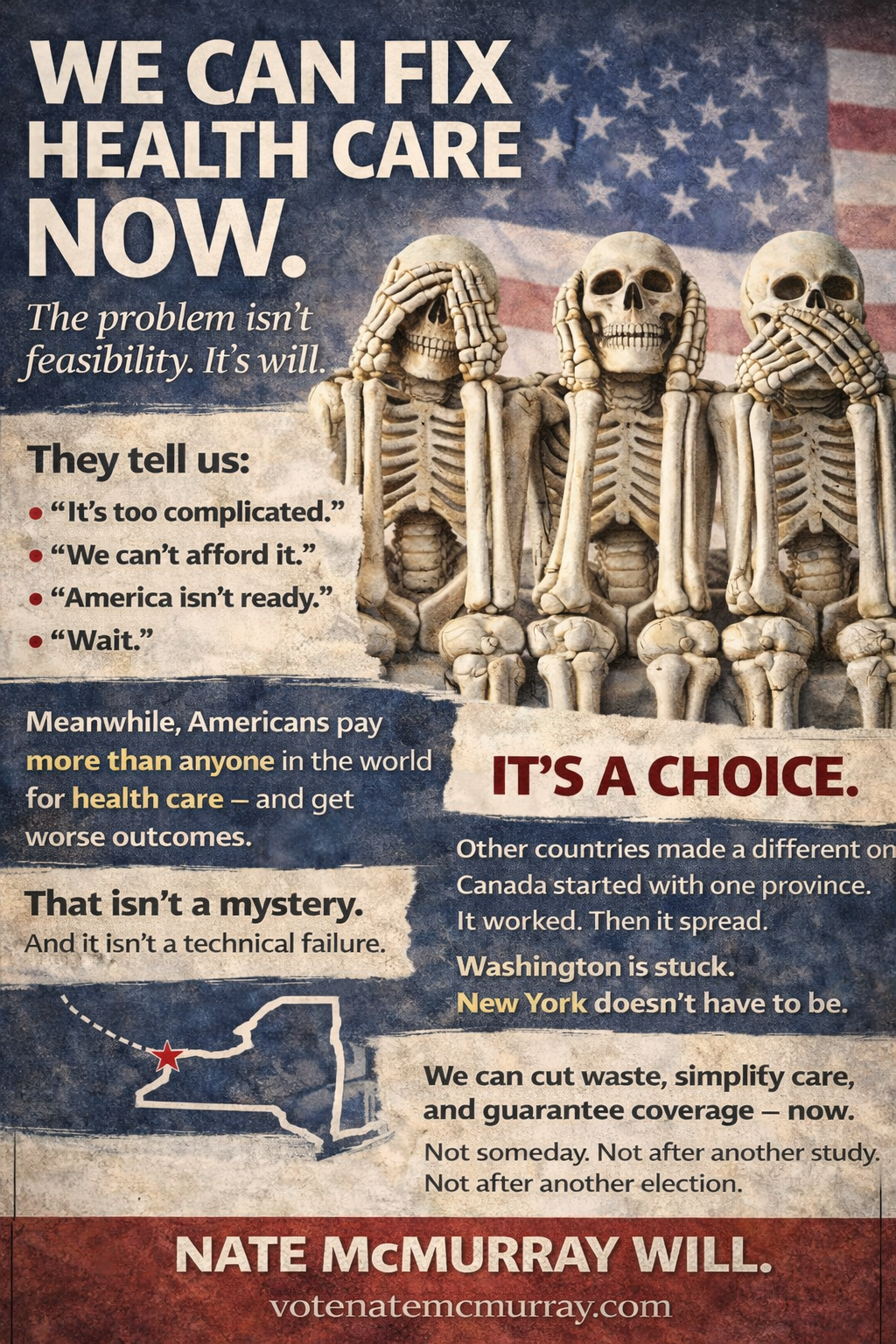
Just Across the River, Health Care Is a Human Right
Stand on the American side of the Niagara River and look north.
Just across the water—in Ontario—everyone has health care as a human right. No premiums. No deductibles. No surprise bills. You get sick, you see a doctor. You break a bone, you get treated. You don’t lose your house because you got cancer.
Cross back over the bridge into the United States, and suddenly health care becomes a commodity—priced, rationed, denied, delayed, and buried under paperwork.
This contrast isn’t abstract. It’s visible. It’s geographic. It’s right in front of us.
And it raises a simple question Americans are told never to ask:
If they can do it, why can’t we?
America Pays More—and Gets Less
The United States spends about $14,000 per person per year on health care—more than any country on Earth. Far more than Canada. Far more than the UK, Germany, France, Japan, Australia, the Netherlands, or the Nordic countries.
And yet we’re constantly told universal health care is “too expensive.”
That argument collapses under even minimal scrutiny.
Canada spends less per person than we do.
Germany spends less.
France spends less.
Japan spends less.
The UK spends far less.
All of them cover everyone.
Meanwhile, Americans pay higher premiums, higher deductibles, higher co-pays—and still face narrow networks, prior authorizations, surprise bills, and medical bankruptcy. Our outcomes trail most developed nations on life expectancy, maternal mortality, and preventable deaths.
This isn’t because Americans are sicker.
It’s because our system is broken.
We Don’t Have a Health Care System—We Have a Crooked Marketplace
Roughly 25–30% of U.S. health care spending goes to administration: billing departments, insurance negotiations, claims processing, marketing, and corporate overhead.
In countries with universal systems, administrative costs are closer to 10%.
That difference represents tens of billions of dollars every year—money wasted on paperwork instead of care.
Universal systems aren’t “bigger government.”
They’re simpler systems.
One public plan.
One primary payer.
Comprehensive coverage.
No premiums.
No deductibles.
No surprise bills.
No medical bankruptcy.
“We Can’t Afford It”—So How Can They?
America’s economy is $30.6 trillion —compared to Canada (~$2.4T), the UK (~$4.2T), Germany (~$5.3T), and France (~$3.6T).
We are by far the richest country in the world,
So when politicians say we “can’t afford” universal health care, what they really mean is this:
We can’t afford to disrupt the current system.
A system that works very well—for insurers, drug companies, politicians, and corporate middlemen.
A system that fails patients every day.
New York Doesn’t Have to Wait
Canada didn’t adopt universal health care overnight. It started in Saskatchewan, where one province proved it could work. Then it spread—province by province—until it became the national standard.
That’s the lesson Americans keep ignoring.
Change doesn’t start in Washington. It starts somewhere.
New York already has a blueprint: the New York Health Act—a single-payer plan that would guarantee coverage for every New Yorker, reduce administrative waste, and shift costs away from premiums and out-of-pocket expenses.
For years, legislative leaders haven’t even allowed a full vote.
Not because it doesn’t work.
Not because it’s unpopular.
But because powerful interests don’t want it debated.
That’s unacceptable.
If elected, I will make sure it gets a vote.
No more burying it.
No more procedural cowardice.
Let the people decide.
Let’s Fix It Here—And Show the Country How
Just across the river, health care is treated as a basic human right.
Here at home, it’s treated as a privilege you can lose with one bad diagnosis.
That’s not inevitable.
It’s a choice.
If Saskatchewan could lead Canada, New York can lead America.
What’s radical isn’t reform.
What’s radical is paying the most in the world and getting the worst deal.
Let’s fix health care in New York first—and show the rest of the country it can be done.
Go to VoteNateMcMurray.com, join us, and help us fix the system.